Phool - A flower delivery app
Phool - A flower delivery app
Phool - A flower delivery app
As a part of my Google UX certification capstone, I designed an end-to-end flower delivery app that balanced personalisation and accessibility, offering one-time & subscription deliveries, customised bouquets and regional language support.
As a part of my Google UX certification capstone, I designed an end-to-end flower delivery app that balanced personalisation and accessibility, offering one-time & subscription deliveries, customised bouquets and regional language support.
My Role
UX/UI Designer, UX Researcher
My team
Solo Designer
Sector
E-commerce
Date
Jun 2021 - Dec 2021
Challenge
Challenge
As someone who loves flowers, I noticed that flower delivery services in India are surprisingly limited and often lack flexibility, personalization, and accessibility. This gap made the problem both challenging and exciting to explore, pushing me to design a thoughtful, scalable solution tailored to the Indian user group.
As someone who loves flowers, I noticed that flower delivery services in India are surprisingly limited and often lack flexibility, personalization, and accessibility. This gap made the problem both challenging and exciting to explore, pushing me to design a thoughtful, scalable solution tailored to the Indian user group.
Design Process
Design Process
I used a design thinking process, starting with understanding user needs and gaps in existing flower delivery services in India. I defined key problems around personalization, flexibility, language, and accessibility, explored multiple concepts, & iterated on the most effective ones to create a inclusive, & emotionally driven experience.
I used a design thinking process, starting with understanding user needs and gaps in existing flower delivery services in India. I defined key problems around personalization, flexibility, language, and accessibility, explored multiple concepts, & iterated on the most effective ones to create a inclusive, & emotionally driven experience.
01
01
Research
Research
Research helps in empathizing with users improves the products you create because you experience the product as the user does and understand how do they feel when they use a product. So to begin with I conducted a couple of research activities.
Research helps in empathizing with users improves the products you create because you experience the product as the user does and understand how do they feel when they use a product. So to begin with I conducted a couple of research activities.
Screener Surveys
Screener Surveys
This being my first screener survey, I received an excellent response from 56 participants. My goals of creating a screener survey were as follows:
This being my first screener survey, I received an excellent response from 56 participants. My goals of creating a screener survey were as follows:
to analyze how do people feel about flowers,
how do people buy flowers (online or in-person),
who my potential interview users are.
to help me understand the when, why, where, and how of flower shopping of the targeted user group.
to analyze how do people feel about flowers,
how do people buy flowers (online or in-person),
who my potential interview users are.
to help me understand the when, why, where, and how of flower shopping of the targeted user group.
 View insights of survey
Some participants quoted…
Some participants quoted…
I never came across an application for flower delivery
There are not many online services that deliver "fresh" flowers to the doorstep.
if i purchased it online will the flowers still remain fresh? And would they be affordable?
Dont know if they are fresh until we look at them by ourselves
We need flowers everyday for god. Placing orders everyday seems like a hassle
Conducting User Interviews
Conducting User Interviews
In the screener survey, I added an optional question asking users whether they were willing to provide their email addresses if they wanted to talk further about their thoughts on the topic. I chose my 5 interview participants from the responses I got.
In order to conduct effective user interviews, I prepared for them beforehand. I created a script of interview questions that I need to ask users.
In the screener survey, I added an optional question asking users whether they were willing to provide their email addresses if they wanted to talk further about their thoughts on the topic. I chose my 5 interview participants from the responses I got.
In order to conduct effective user interviews, I prepared for them beforehand. I created a script of interview questions that I need to ask users.
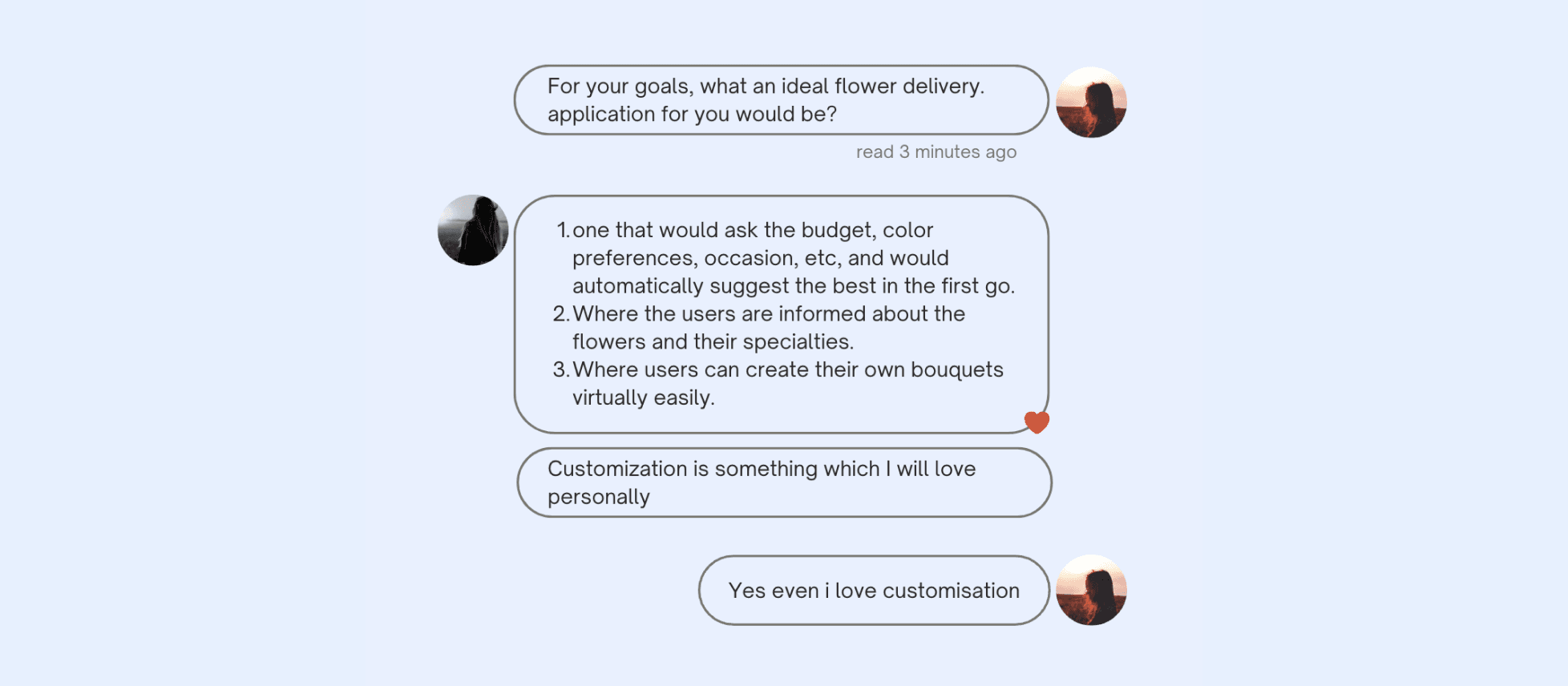
a glimpse of user interview
Creating Empathy Maps
Creating Empathy Maps
While conducting interviews, I started to understand what are the users’ painpoints. I created one-user empathy maps from the interview transcripts to understand more about what the user says, feels, thinks, and does in a concise manner. One of the common user painpoints was: difficulty in getting good quality flowers at a reasonable price.
While conducting interviews, I started to understand what are the users’ painpoints. I created one-user empathy maps from the interview transcripts to understand more about what the user says, feels, thinks, and does in a concise manner. One of the common user painpoints was: difficulty in getting good quality flowers at a reasonable price.
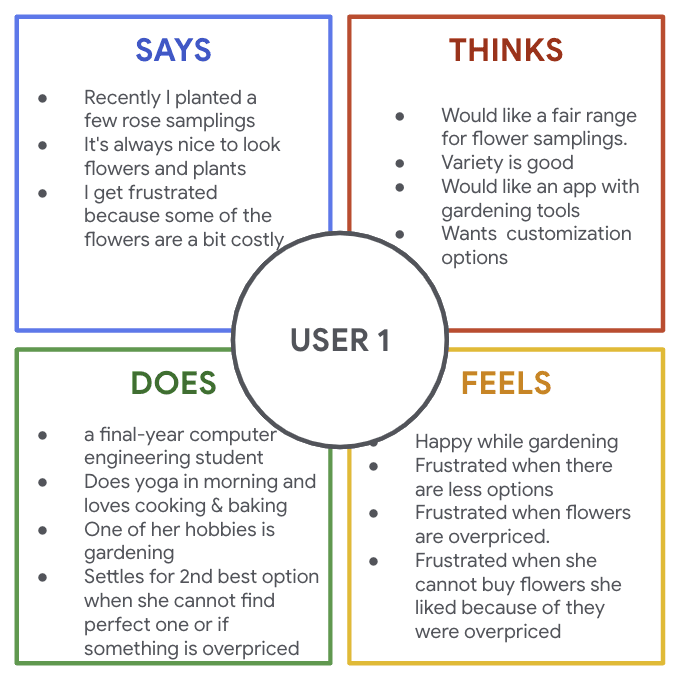
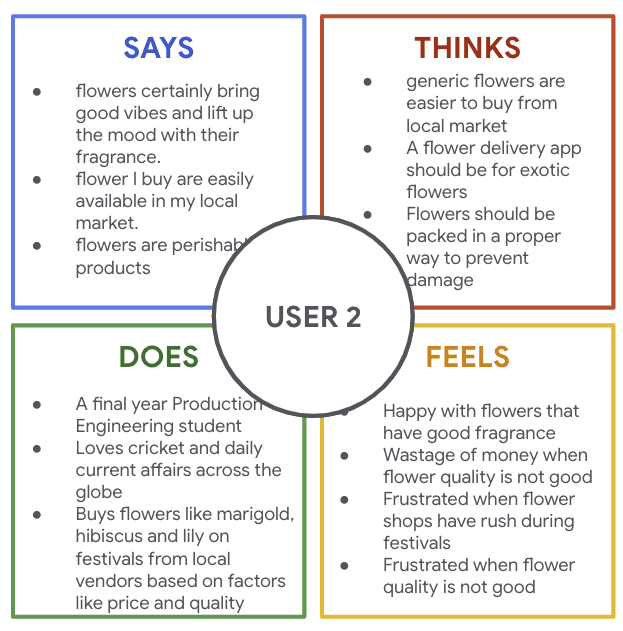
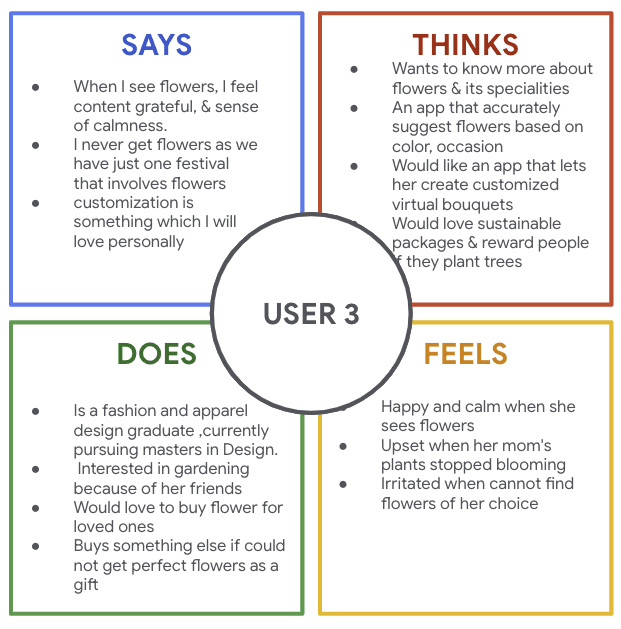
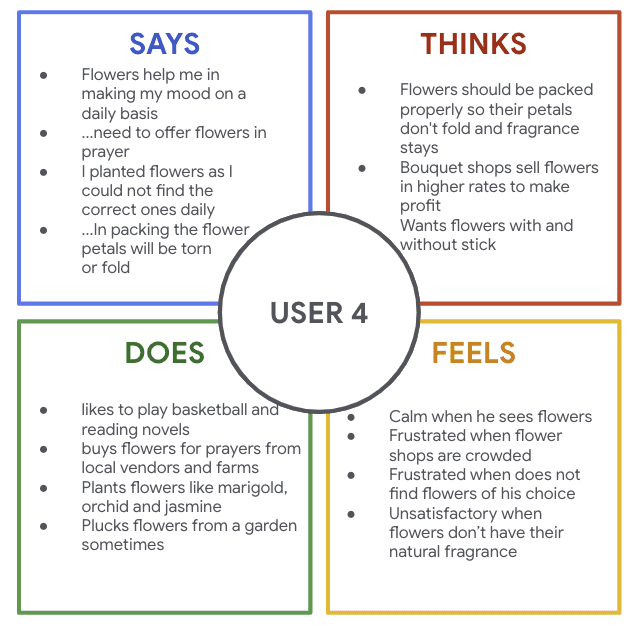
empathy maps
Creating User Persona
Creating User Persona
Because User 2 and User 4 had similar painpoints and experiences, I merged their empathy maps to create the user persona “Aryan”. Due to busy florist stores, they both found it difficult to choose the perfect flowers every day and for festivals. User 4 needed flowers daily because they were used as an offering to god in daily prayers. Hence the goal of the persona “Aryan” is to find good-quality flowers at a reasonable price and did not fold petals when packed.
User 1 and User 3 had the same interest, that of gardening. Using their empathy maps, I created the second user persona “Sara”. The goal of Sara is buying flowers and plants for her gardens, as well as for learn how to care for the purchased flowers and plants.
Because User 2 and User 4 had similar painpoints and experiences, I merged their empathy maps to create the user persona “Aryan”. Due to busy florist stores, they both found it difficult to choose the perfect flowers every day and for festivals. User 4 needed flowers daily because they were used as an offering to god in daily prayers. Hence the goal of the persona “Aryan” is to find good-quality flowers at a reasonable price and did not fold petals when packed.
User 1 and User 3 had the same interest, that of gardening. Using their empathy maps, I created the second user persona “Sara”. The goal of Sara is buying flowers and plants for her gardens, as well as for learn how to care for the purchased flowers and plants.
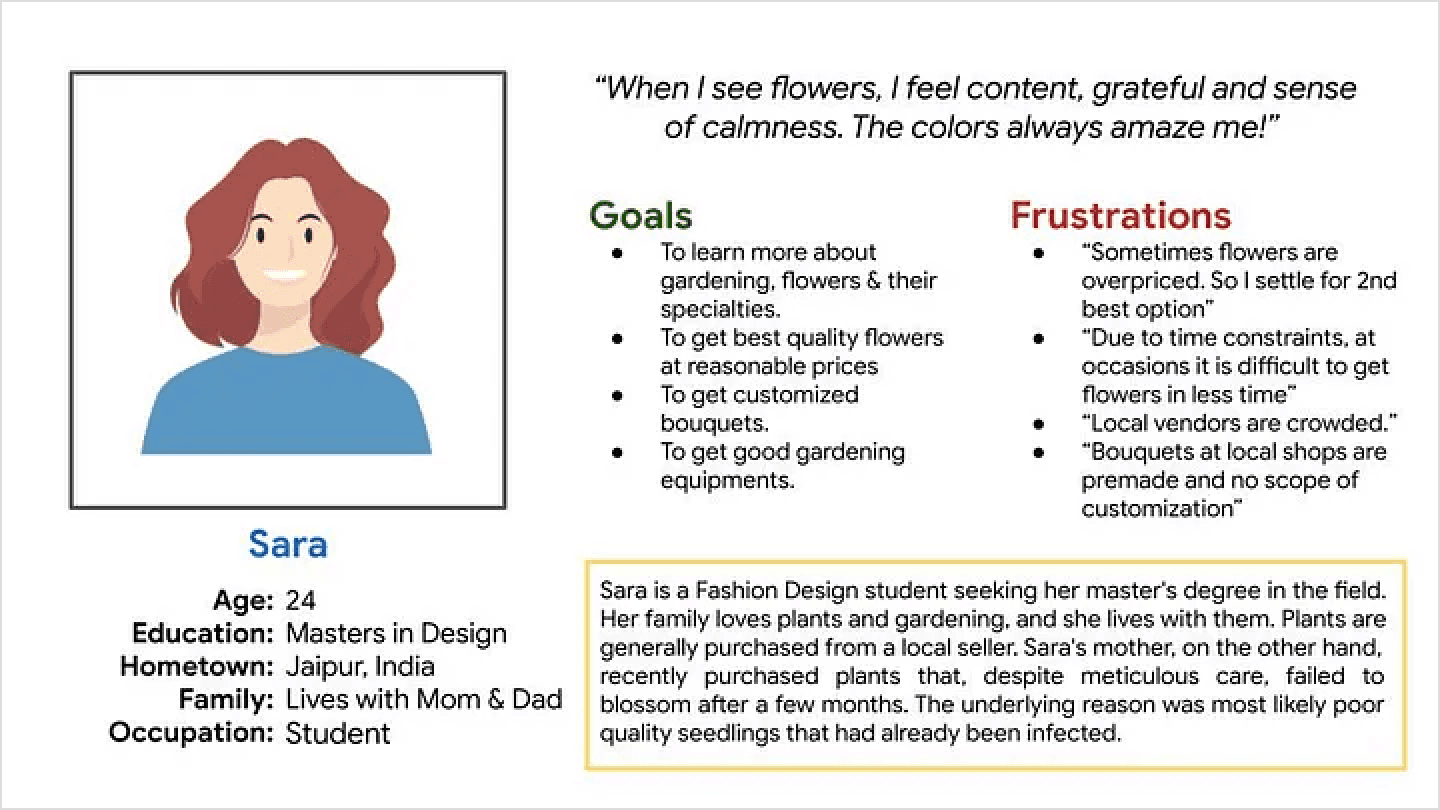
User Persona: Sara
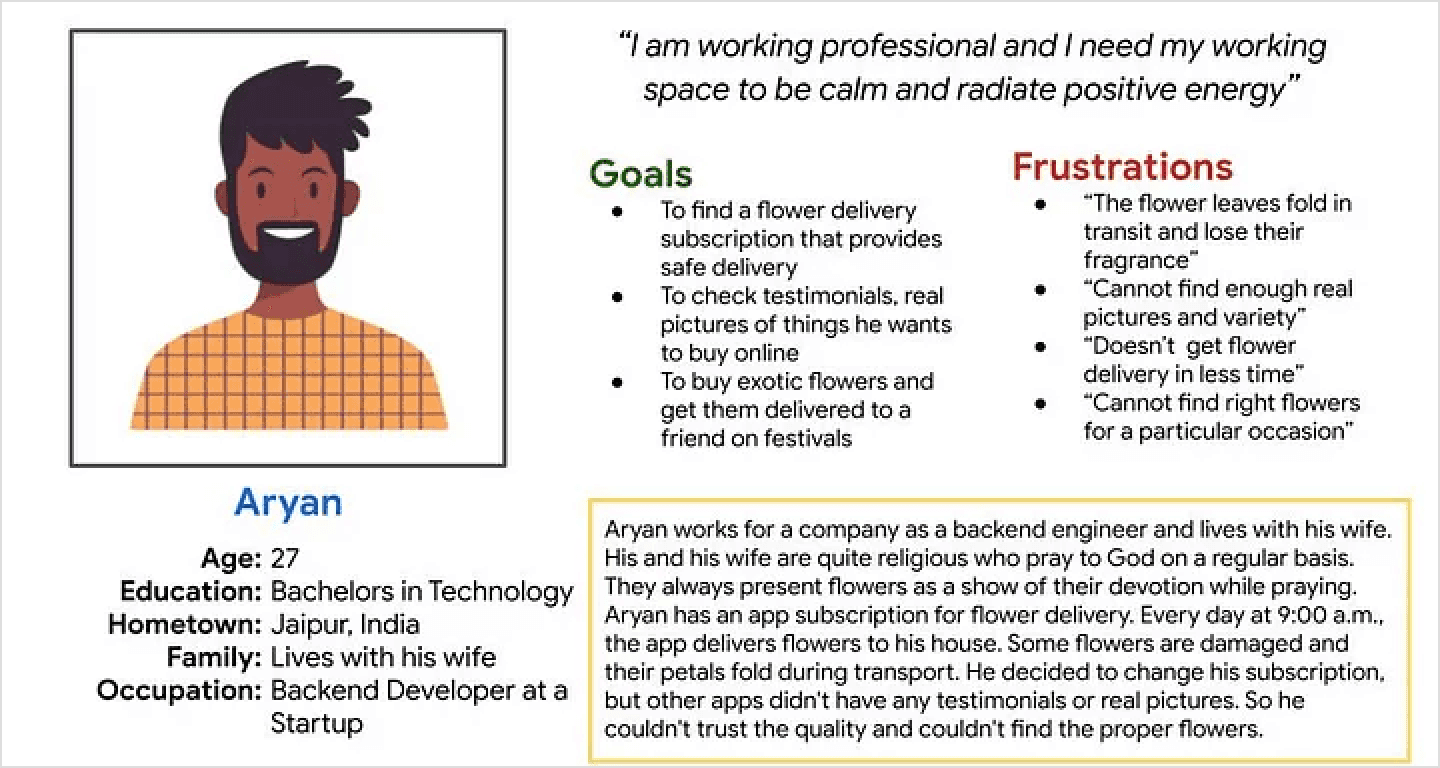
User Persona: Aryan
Crafting User Stories
Crafting User Stories
I created user stories from the persona’s point of view to inspire and inform my design decisions. They also served as a checklist to make sure that I am addressing the key problems and prioritizing my design goals.
I created user stories from the persona’s point of view to inspire and inform my design decisions. They also served as a checklist to make sure that I am addressing the key problems and prioritizing my design goals.
02
02
Define Phase
Define Phase
In the define phase, I synthesized everything I did in the empathize phase to design a user-centric solution and define the expectations, concerns, and motivations of my target user group.
In the define phase, I synthesized everything I did in the empathize phase to design a user-centric solution and define the expectations, concerns, and motivations of my target user group.
Re-defining the problem statement
Re-defining the problem statement
Defining a problem statement allowed me to better understand the needs of users and the restrictions they encounter whether purchasing flowers from a local vendor or an online flower delivery service.
Defining a problem statement allowed me to better understand the needs of users and the restrictions they encounter whether purchasing flowers from a local vendor or an online flower delivery service.
Aryan is a busy working professional who needs fresh flowers of good quality every morning because he wants to offer those flowers to god as a sign of his devotion while he prays
Defining the hypothesis statement
Defining the hypothesis statement
Defining a hypothesis statement allowed me to think about the possible solutions to the problem my target user group faces.
Defining a hypothesis statement allowed me to think about the possible solutions to the problem my target user group faces.
If Aryan downloads a flower delivery application then he can subscribe to a flower delivery subscription that delivers flowers everyday at his doorstep.
Determining Value Proposition
Determining Value Proposition
I followed two steps to come up with the value proposition.
List the product’s features and benefits: In this step, I simply listed all the features my product can have. I listed every feature that came to mind without holding anything back.
Explain the value of the product: In this step, I sorted out the features into four categories as Accessibility, Cost, Reliability, and Variety & Uniqueness.
I followed two steps to come up with the value proposition.
List the product’s features and benefits: In this step, I simply listed all the features my product can have. I listed every feature that came to mind without holding anything back.
Explain the value of the product: In this step, I sorted out the features into four categories as Accessibility, Cost, Reliability, and Variety & Uniqueness.
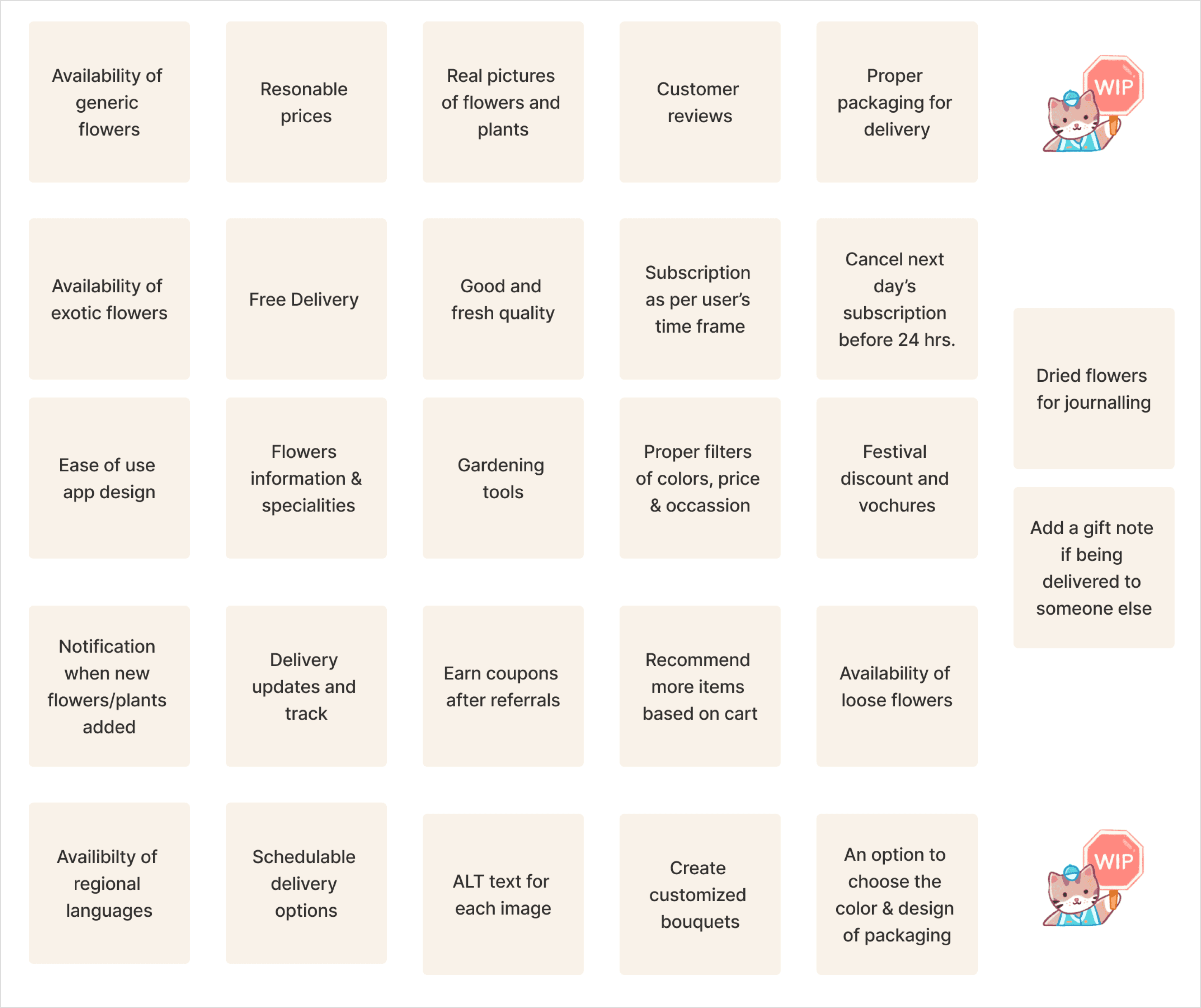
output of step 1
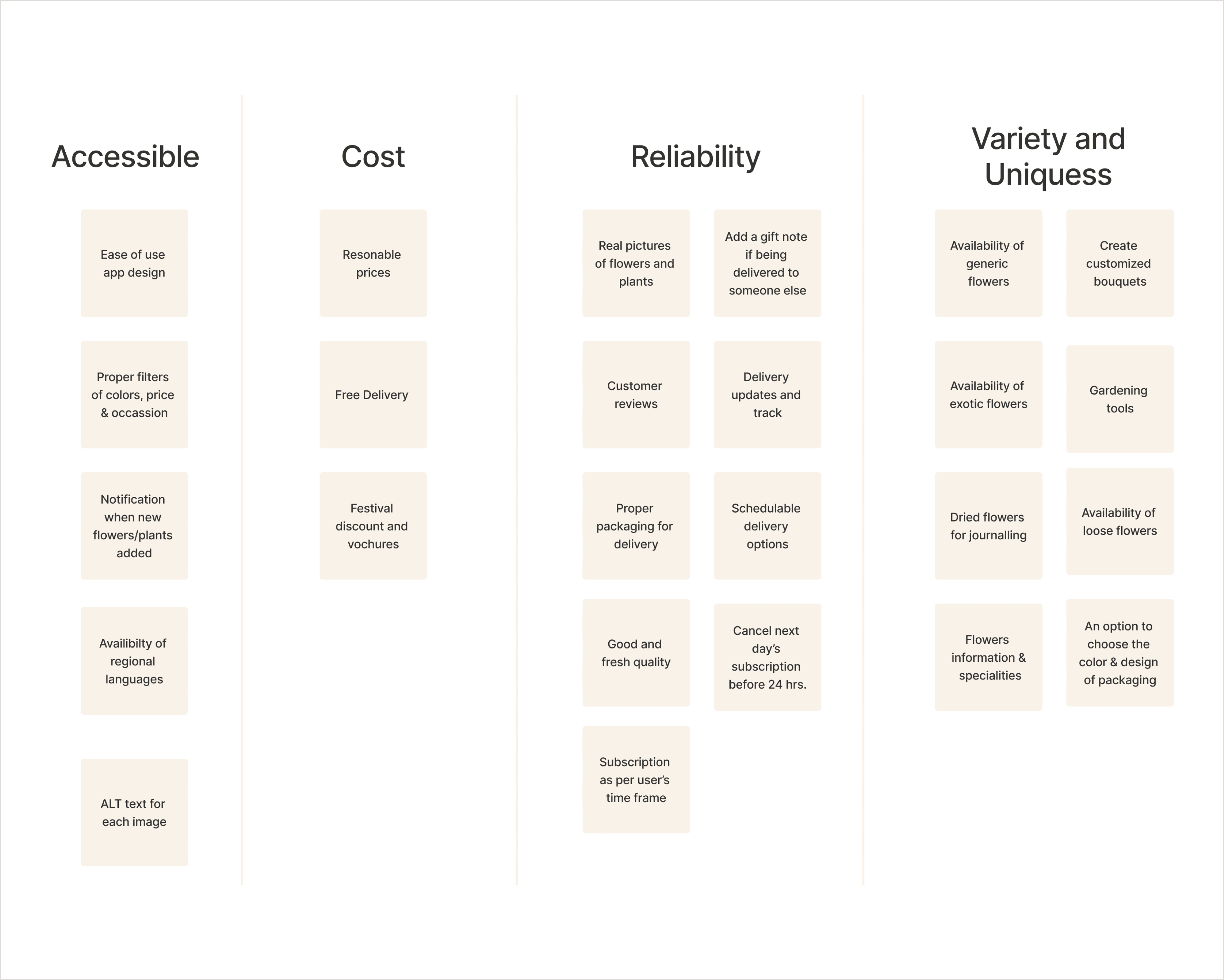
output of step 2
03
03
Ideation
Ideation
Competitor Audit and Analysis
Competitor Audit and Analysis
I evaluated one direct competitor and three indirect competitors for the competitive audit. The majority of the applications I found sent bouquets and other gifts, but none of them offered both generic and exotic flowers. A detailed competitive audit of all four apps can be viewed here whereas a detailed report of analysis can be found here!
I evaluated one direct competitor and three indirect competitors for the competitive audit. The majority of the applications I found sent bouquets and other gifts, but none of them offered both generic and exotic flowers. A detailed competitive audit of all four apps can be viewed here whereas a detailed report of analysis can be found here!
How Might We Exercise
How Might We Exercise
The aim was to generate lots of ideas even if some of them sounded weird at first! After analyzing the gaps in competitors applications and deriving opportunities for my product, I started ideating through various techniques like HMW, Crazy 8 and simple pen and paper!
Some of the HMW I came up with are
The aim was to generate lots of ideas even if some of them sounded weird at first! After analyzing the gaps in competitors applications and deriving opportunities for my product, I started ideating through various techniques like HMW, Crazy 8 and simple pen and paper!
Some of the HMW I came up with are
Amp up the good: HMW help users to buy fresh flowers every day or on occasions?
Explore the opposite: HMW create a way to make flower shopping from florists easier?
Go after adjectives: HMW make it less time-consuming for the user to buy flowers?
Create an analogy from need or context: HMW make the flower shopping process easier like making a cup of coffee?
Play POV against the challenge: HMW prevent flower petals from folding after buying them from a florist?
Change the status quo: HMW avoid going to crowded florist shops on festivals?
Amp up the good: HMW help users to buy fresh flowers every day or on occasions?
Explore the opposite: HMW create a way to make flower shopping from florists easier?
Go after adjectives: HMW make it less time-consuming for the user to buy flowers?
Create an analogy from need or context: HMW make the flower shopping process easier like making a cup of coffee?
Play POV against the challenge: HMW prevent flower petals from folding after buying them from a florist?
Change the status quo: HMW avoid going to crowded florist shops on festivals?
Core Functionalities
Core Functionalities
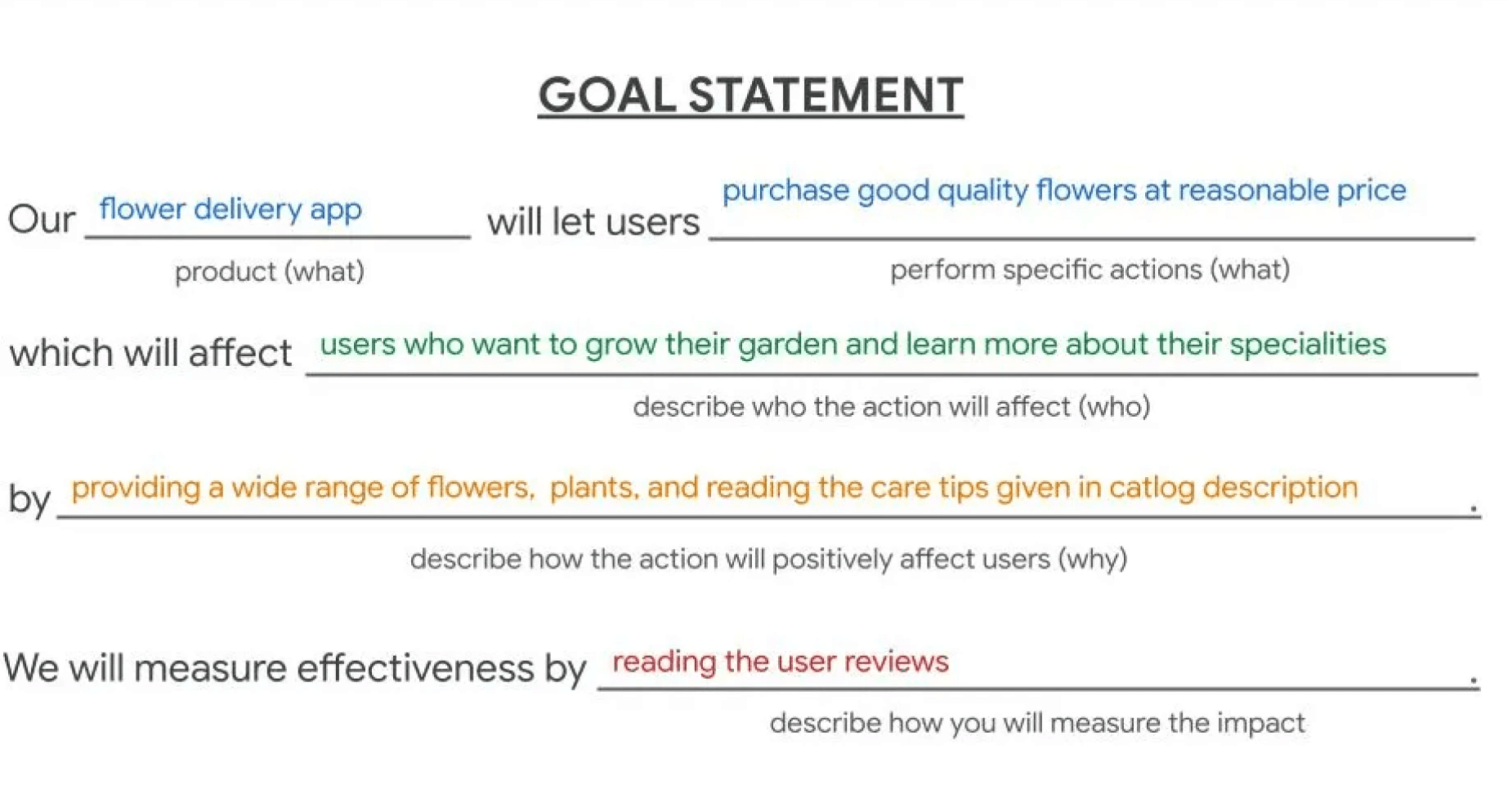
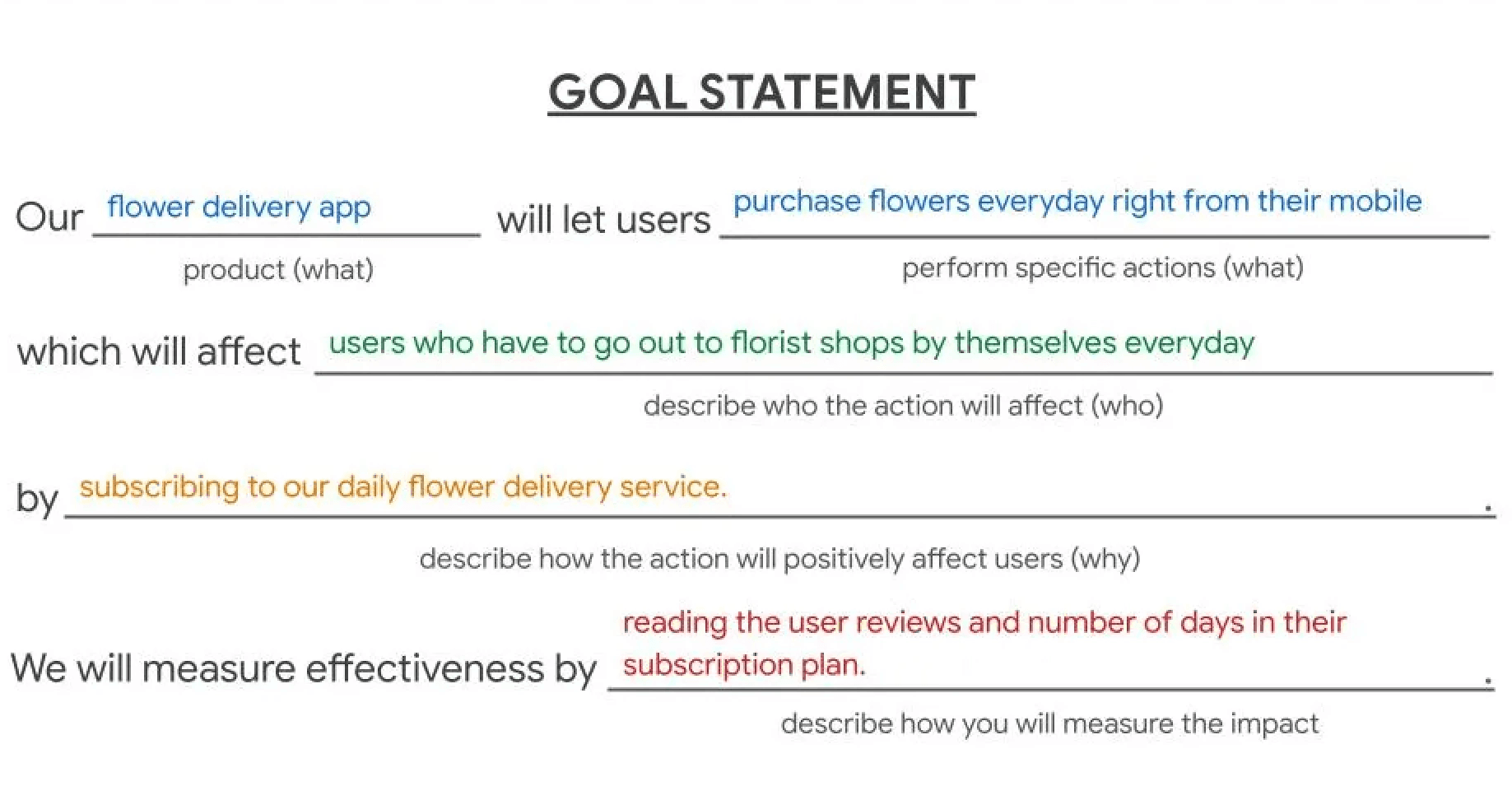
To derive core functionalities of my solution, I built 2 goal statements for both of my personas, Aryan and Sara. The goal statements helped me describe my product and its benefits for my targeted user group.
To derive core functionalities of my solution, I built 2 goal statements for both of my personas, Aryan and Sara. The goal statements helped me describe my product and its benefits for my targeted user group.
04
04
Design Iteration 1
Design Iteration 1
User Flow
User Flow
I outlined the typical path user will take while ordering flowers online. I referenced the problem statements I created to make sure that my design really addresses the user’s needs.
I outlined the typical path user will take while ordering flowers online. I referenced the problem statements I created to make sure that my design really addresses the user’s needs.
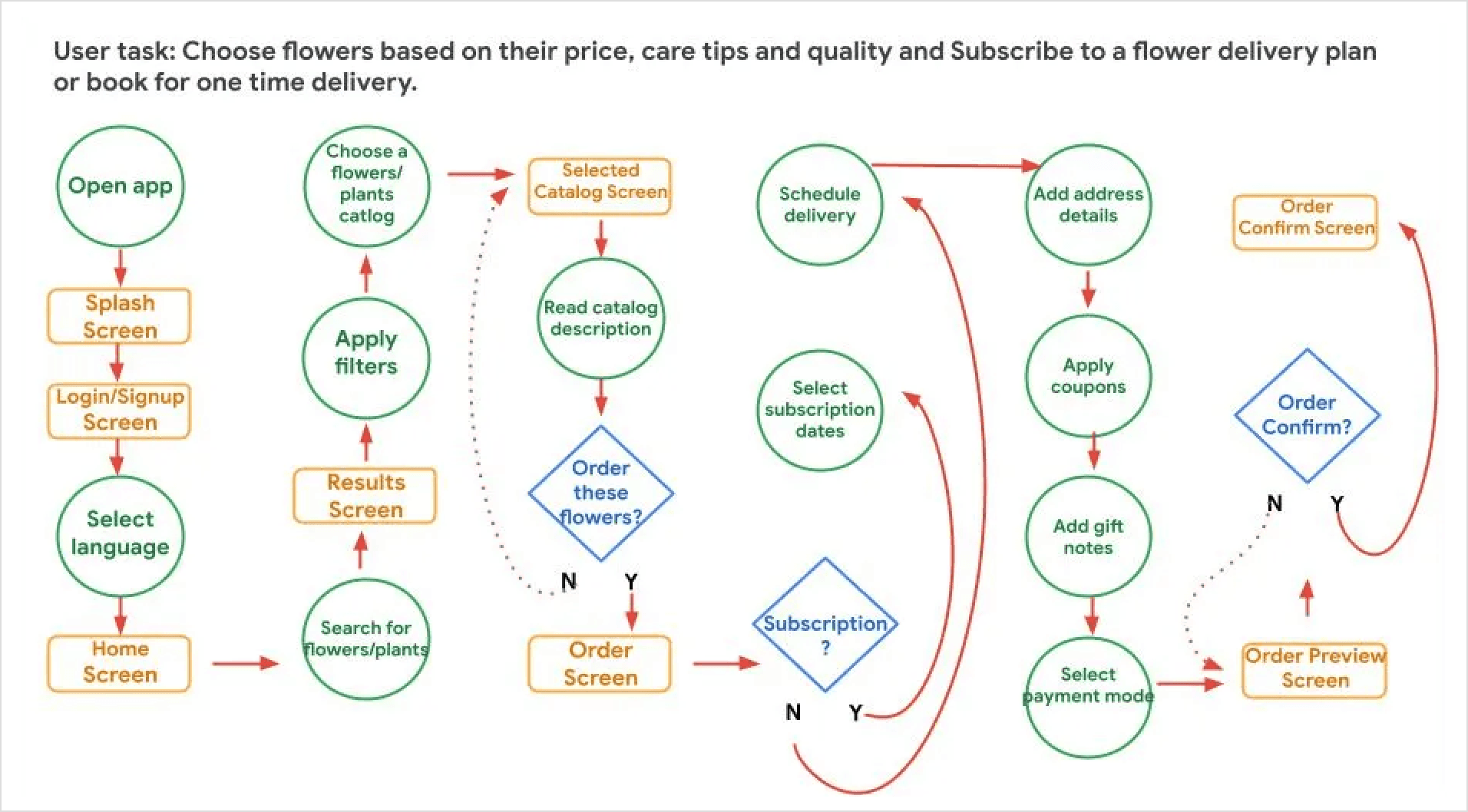
User flow of the app
Sketches and Wireframes
Sketches and Wireframes
I quickly drew out sketches of these functionalities on paper which I later digitalized using Figma. At first, I sketched four to five screens for my homepage using paper. Then I created one refined one wireframe for my homepage and repeated the same process for the rest of the screens.
I quickly drew out sketches of these functionalities on paper which I later digitalized using Figma. At first, I sketched four to five screens for my homepage using paper. Then I created one refined one wireframe for my homepage and repeated the same process for the rest of the screens.
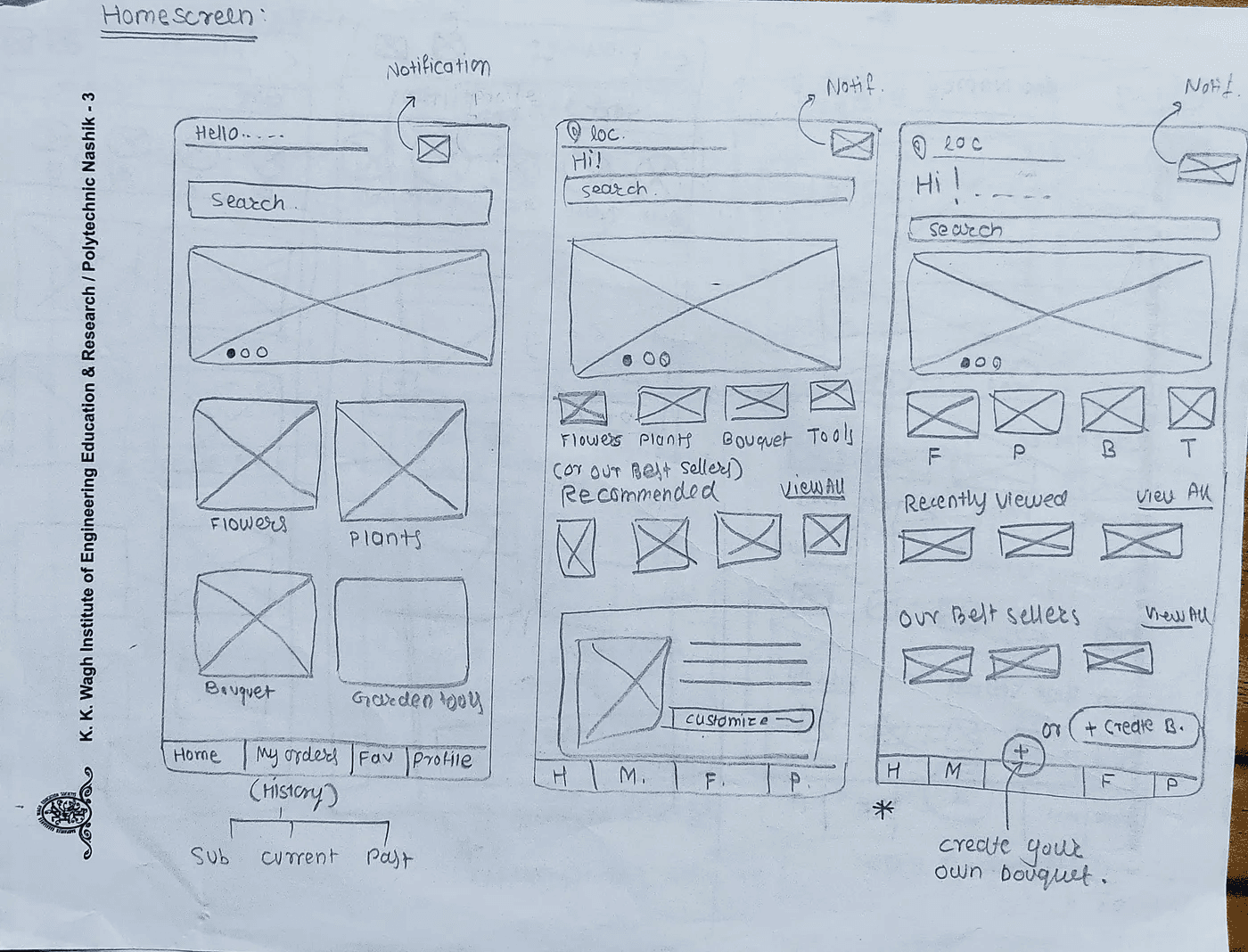
Paper Wireframes
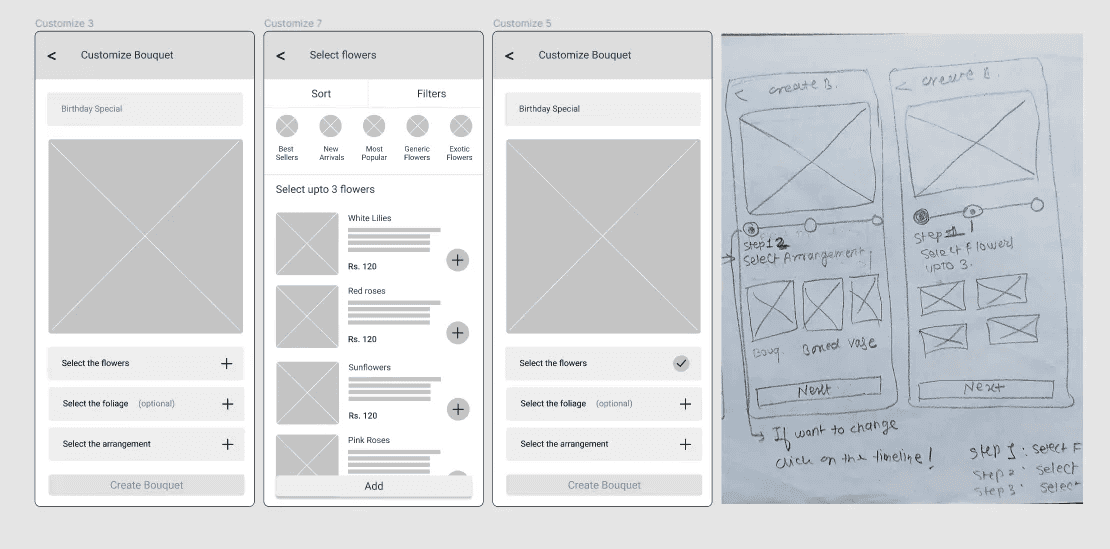
Wireframes for customising a bouquet
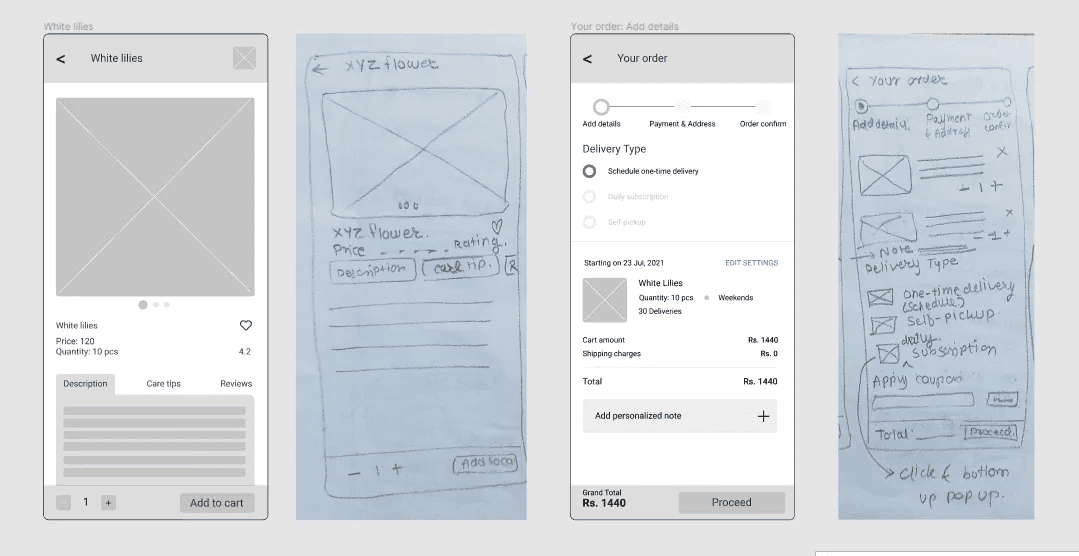
Wireframes to order a bouquet
05
05
Usability Testing
Usability Testing
After the first iteration of my digital wireframes, I decided to conducted moderated usability study for 5 users of my target audience to understand whether the users can use the application while being on the happy path or they are getting diverted.
After the first iteration of my digital wireframes, I decided to conducted moderated usability study for 5 users of my target audience to understand whether the users can use the application while being on the happy path or they are getting diverted.
Here's a brief overview of the process:
Created a usability research plan including objectives of study, questionnaire, KPIs and identify participants. View the detailed reserach plan here.
During study interview, introduced the project goal, and put users at ease.
Described the scenario, set up the context, and allowed the users to use the app while thinking aloud.
Asked follow up questions and gathered feedback.
Asked users to fill out a questionnaire. Thanked them for participation.
Analyzed and synthesized the results of usability study. View the study results here.
Here's a brief overview of the process:
Created a usability research plan including objectives of study, questionnaire, KPIs and identify participants. View the detailed reserach plan here.
During study interview, introduced the project goal, and put users at ease.
Described the scenario, set up the context, and allowed the users to use the app while thinking aloud.
Asked follow up questions and gathered feedback.
Asked users to fill out a questionnaire. Thanked them for participation.
Analyzed and synthesized the results of usability study. View the study results here.
After the usability study, I had a ton of feedback from participants. The next step in the course was to analyze and synthesize the results by doing the following steps:
After the usability study, I had a ton of feedback from participants. The next step in the course was to analyze and synthesize the results by doing the following steps:
Create an affinity map from usability study data into sticky notes participant-wise and then similarity-wise.
Create an affinity map from usability study data into sticky notes participant-wise and then similarity-wise.
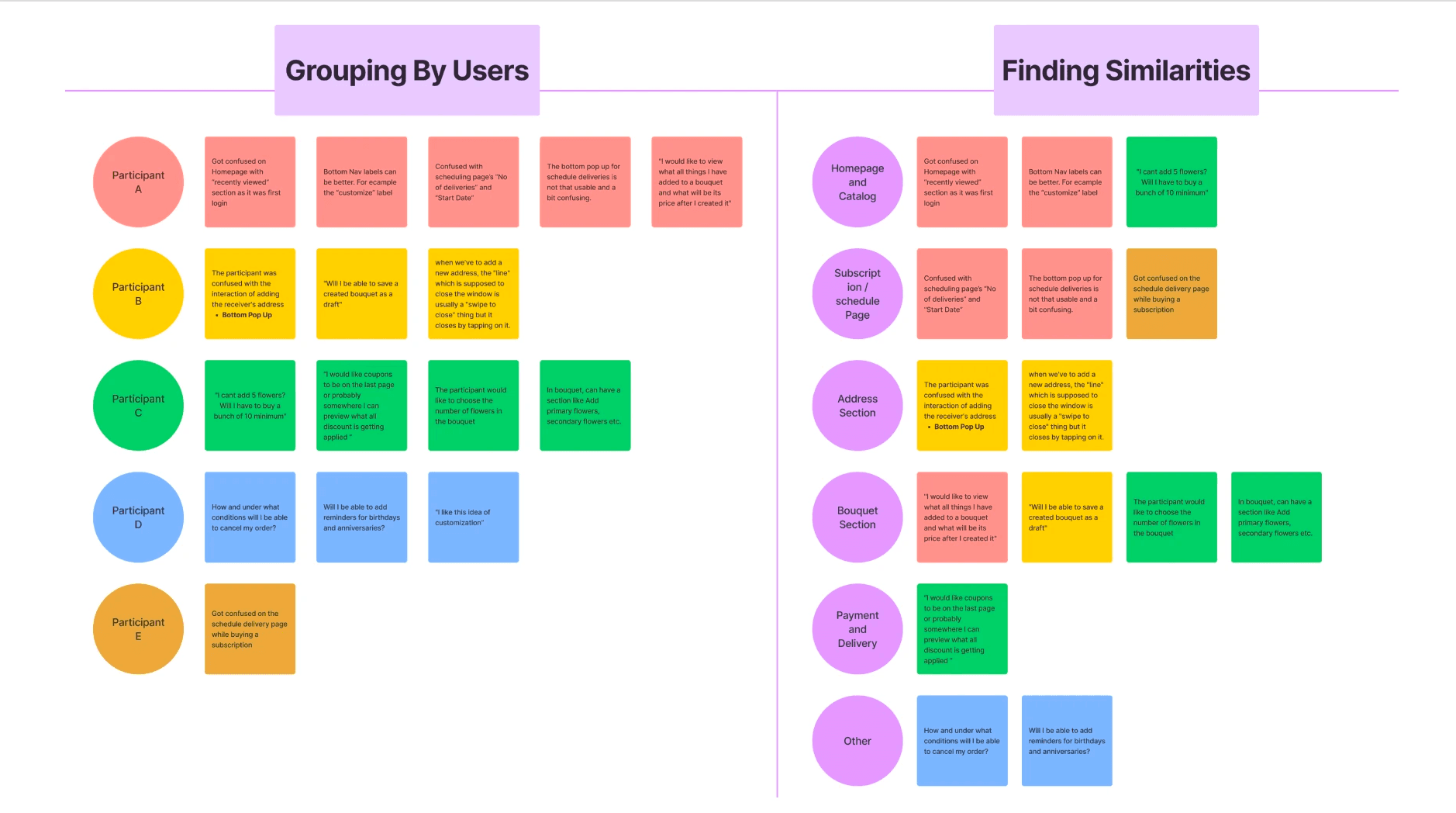
At last I came up with insights for each theme. I wrote an insight that tells how to improve the product based on a theme. In total I came up with 6 insights which you can view here.
At last I came up with insights for each theme. I wrote an insight that tells how to improve the product based on a theme. In total I came up with 6 insights which you can view here.
06
06
Design Iteration 2
Design Iteration 2
Usually, its helpful to prioritise your research insights from the most urgent to the least urgent. As this was a mini project and had only 4 insights, I decided to go ahead and fix all of the usability issues.
Usually, its helpful to prioritise your research insights from the most urgent to the least urgent. As this was a mini project and had only 4 insights, I decided to go ahead and fix all of the usability issues.
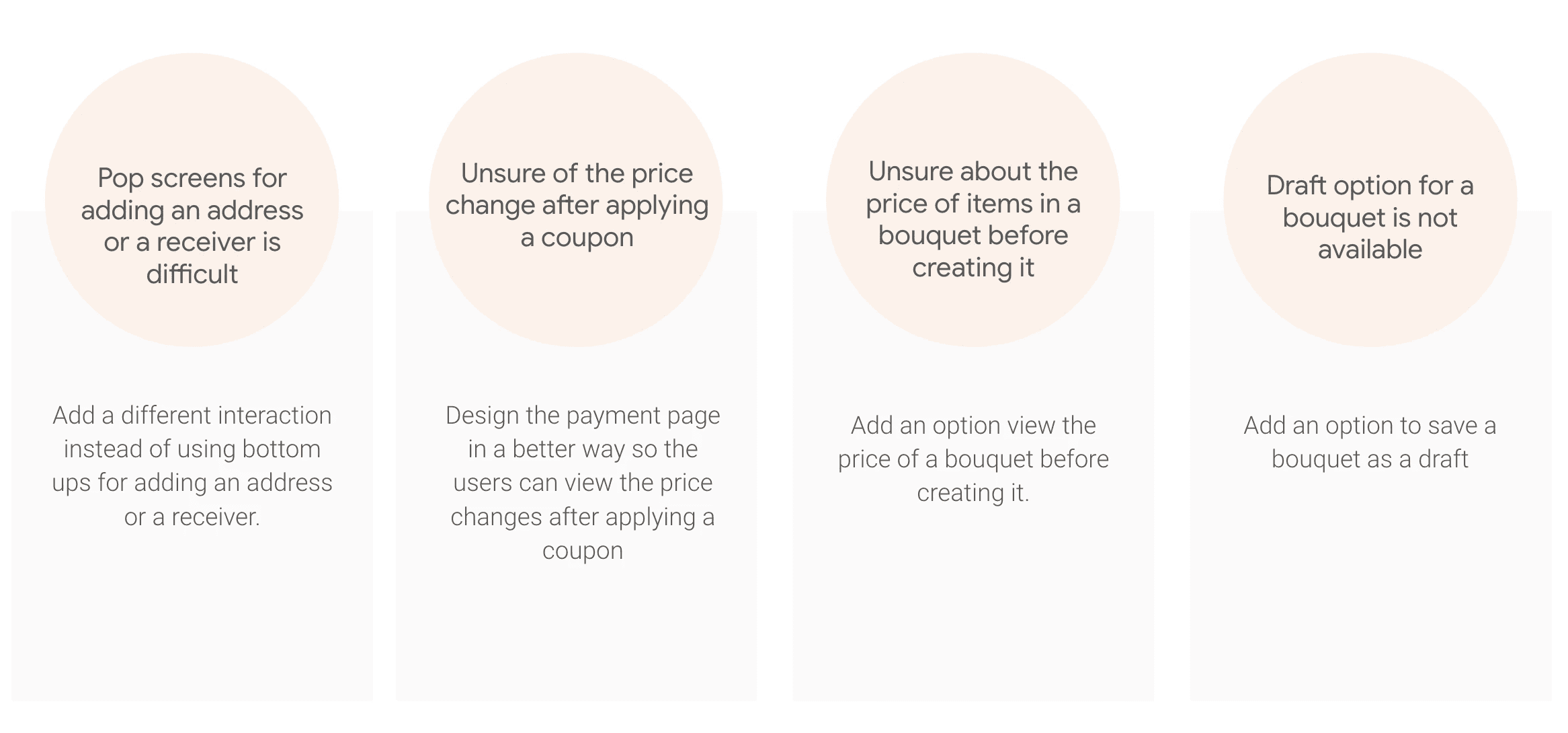

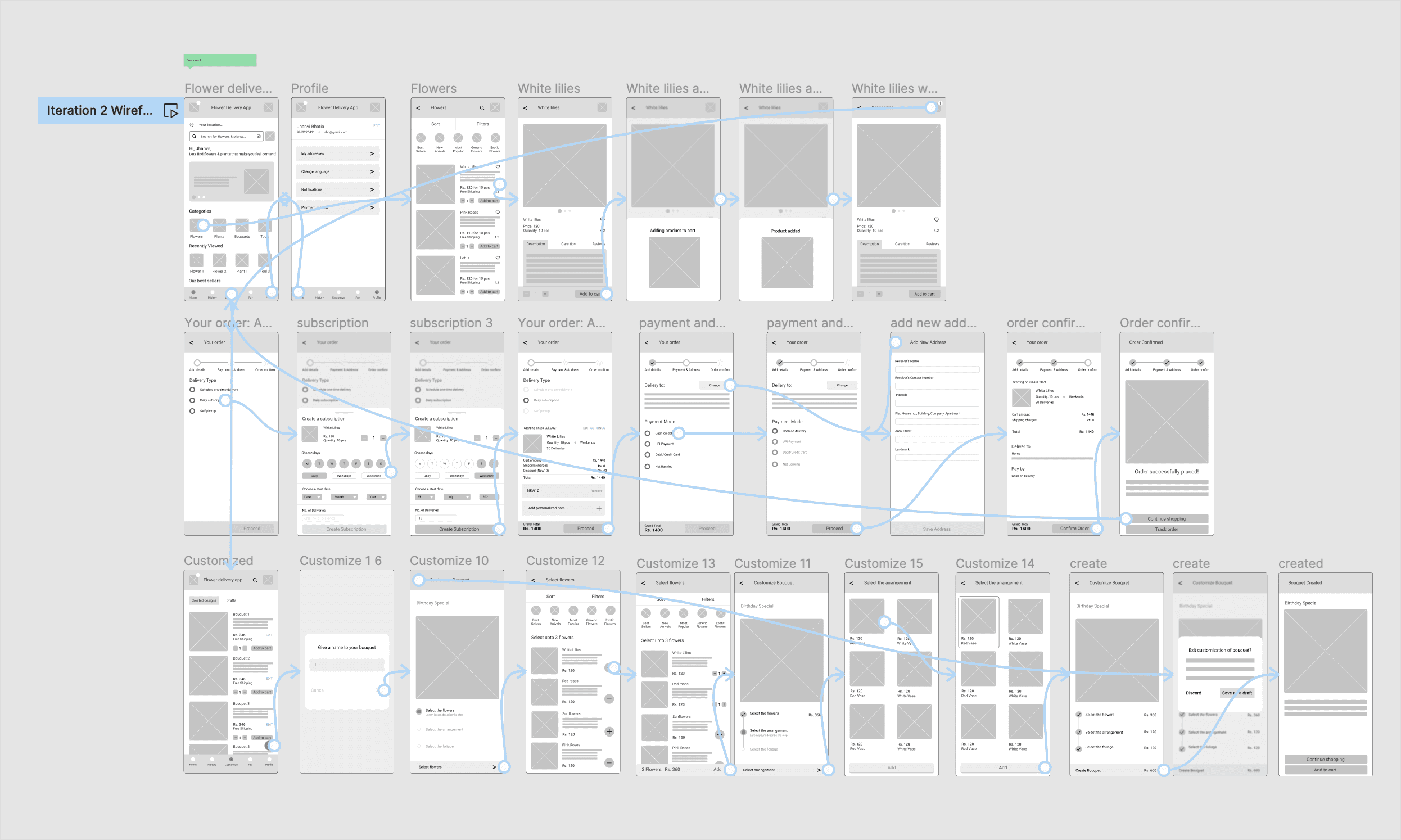
The new design aims to give users enough information to make a decision at a glance. Below is a brief comparison between the wireframes before and after integrating user feedback:
The new design aims to give users enough information to make a decision at a glance. Below is a brief comparison between the wireframes before and after integrating user feedback:
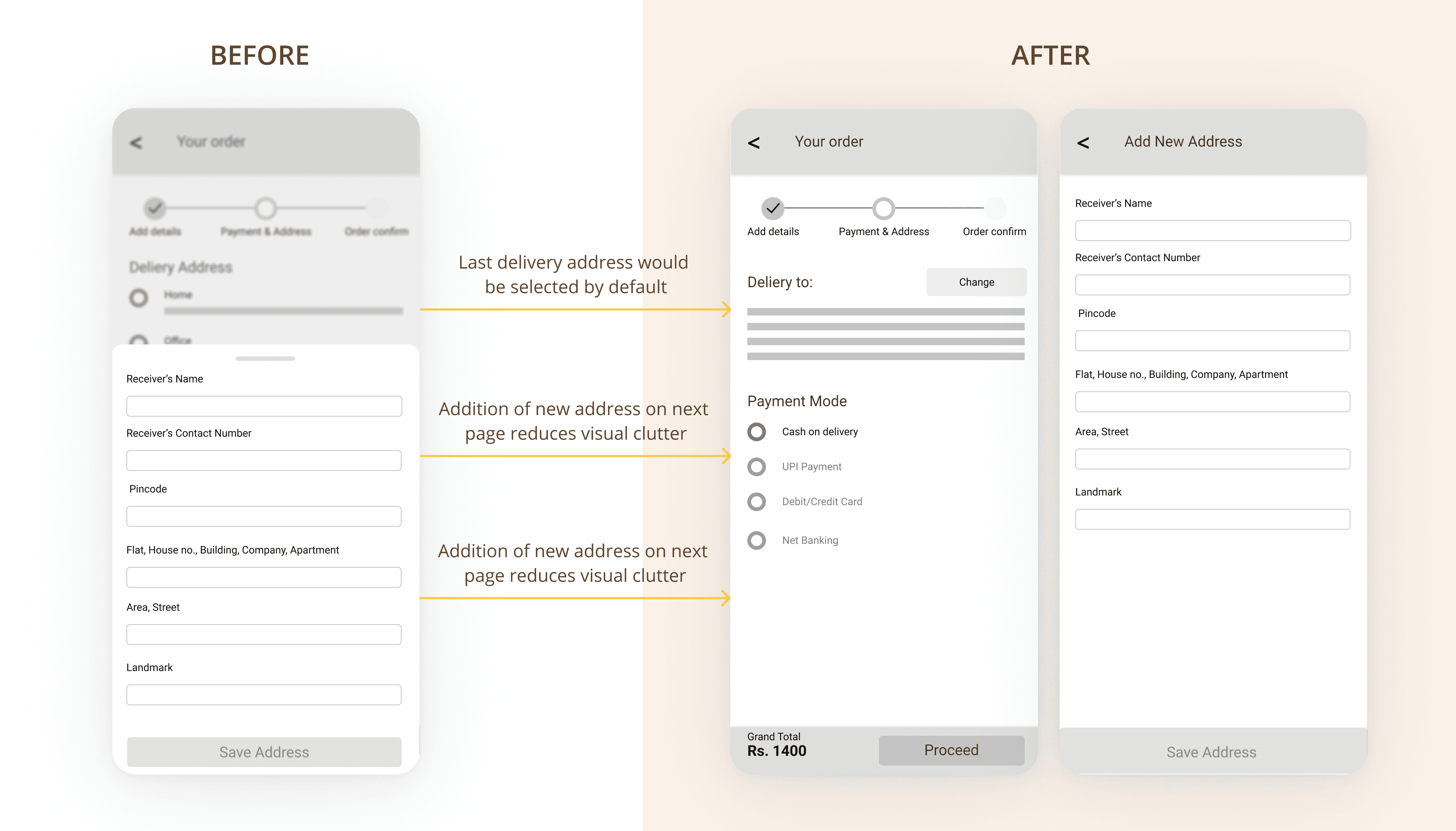
Adding a new address
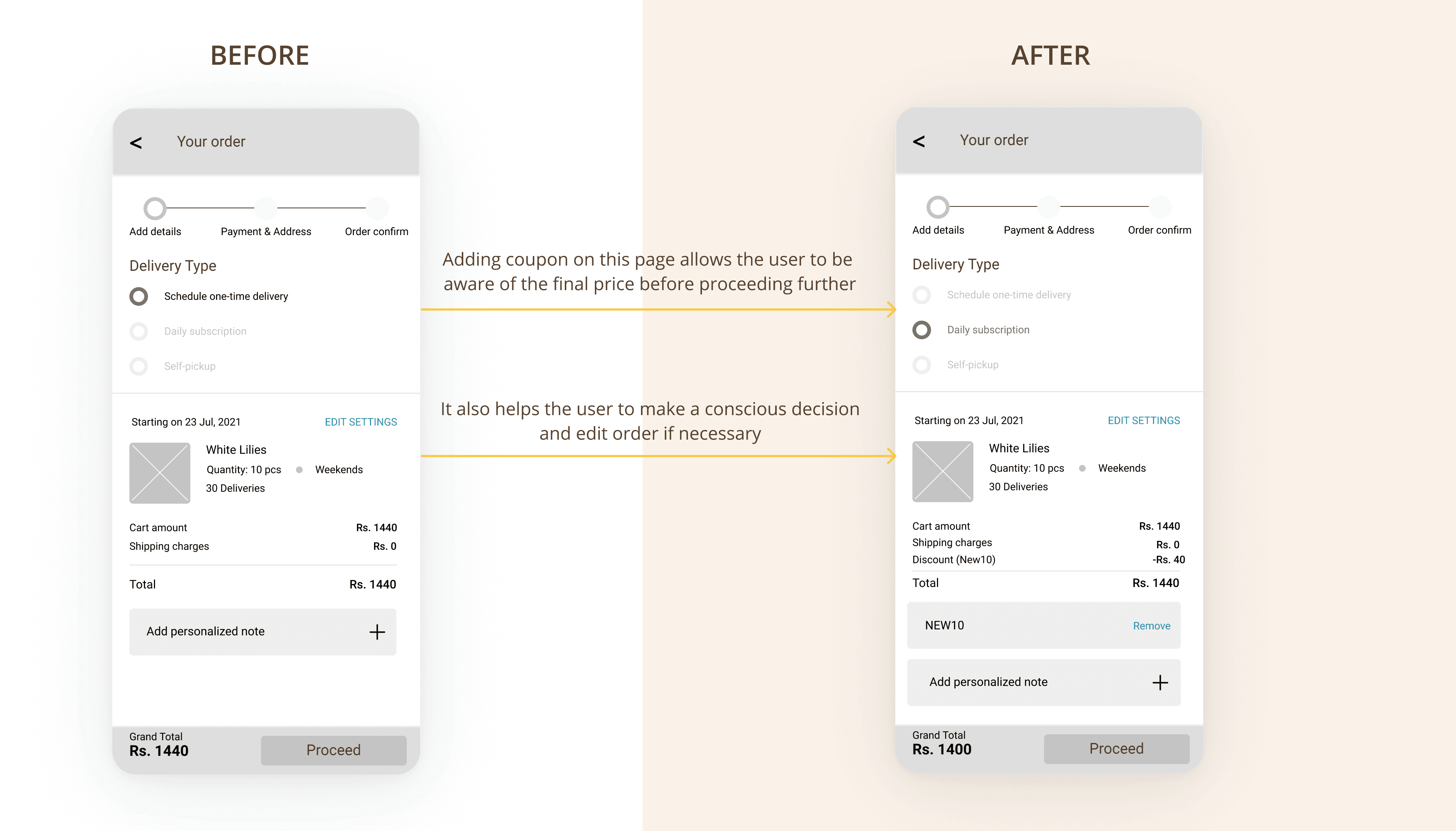
Applying a coupon
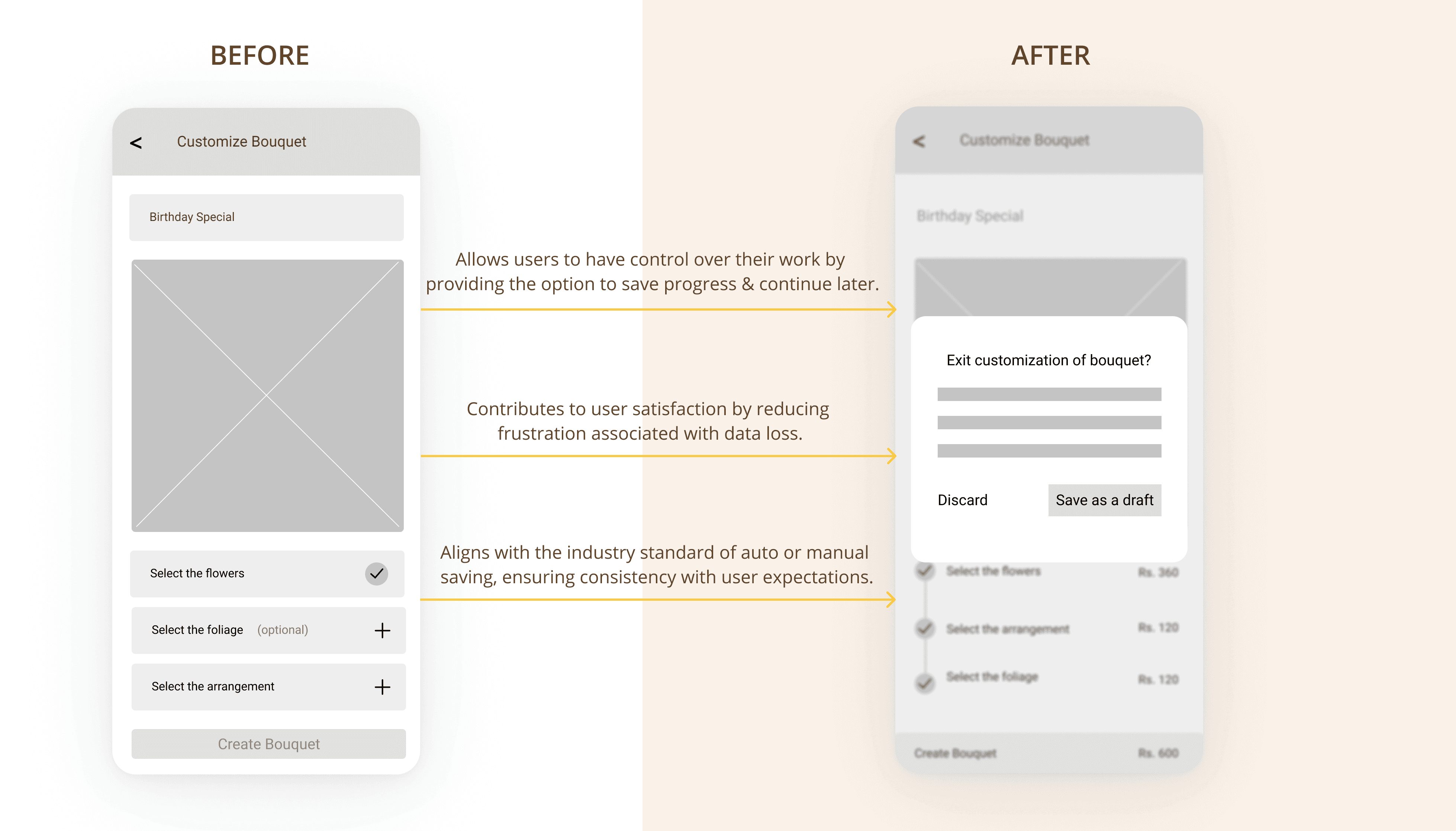
Saving bouquet as a draft
08
08
The Implementation
The Implementation
I am currently vibe coding this app in partnership with Claude Code & Figma. Below is a small glimpse of it!
I am currently vibe coding this app in partnership with Claude Code & Figma. Below is a small glimpse of it!
09
09
Conclusion
Conclusion
This is my first ever case study and it was super fun to learn the entire UX process. Thank you for reading!
This is my first ever case study and it was super fun to learn the entire UX process. Thank you for reading!
initial designing days :)